

The Short Version
Stream in 30 Seconds
01
STREAM stands for Science, Technology, Reading & Religion, Engineering, Arts, and Math. At Enlightium, faith is not one subject among six. It runs through all of them.
02
Author Frans Johansson argues that breakthrough ideas tend to come from people who connect different fields. He calls it the Medici Effect, after the family whose patronage helped turn Florence into the birthplace of the Renaissance.
03
AI is very good at predictable work. It makes the expected answer cheap. What stays valuable is the ability to connect ideas, build real things, and judge what is true and what is right.
04
STREAM trains exactly those abilities. Enlightium adds two things most schools don't: a schedule that frees up real time for projects, and AI skills built into the curriculum.
05
The goal is graduates who can think like scientists, build like engineers, create like artists, and decide like people of faith.
WHAT IS STREAM?
STREAM Is A Way of Teaching, Not A Single Class
STREAM is a way of teaching, not a single class. Students still learn each subject in depth. They also learn to use the subjects together, because real problems never arrive sorted by subject.
Here is what each letter means at Enlightium, what it looks like in practice, and why it matters more now that AI is part of everyday life.

Science
Explore God's creation through observation, experiments, and evidence.
What it looks like
Hands-on labs, nature journaling, the scientific method, and honest questions about our responsibility for what we discover.
Why it matters now
AI can summarize what is already known. Science teaches students to discover what isn't.

Technology
Use tools well, and use them for good.
What it looks like
Coding, 3D printing, robotics, working apps, and AI-powered projects. Students learn to direct AI agents and set up simple automated workflows.
Why it matters now
Students who build with AI will lead students who only consume it.

Reading + Religion
The center of the model. Every other letter runs through this one.
What it looks like
Strong reading and writing, Scripture memory, chapel, Bible study, and a biblical worldview that shapes how students read, weigh evidence, and make decisions.
Why it matters now
Reading teaches students to judge what is true. Faith teaches them to judge what is right. AI can't do either for them.

Engineering
Design, build, test, improve.
What it looks like
Design challenges rooted in serving real people, with real materials and real limits.
WHY it matters now
Ideas are cheap. Working solutions that actually help someone are not.

Art
Make meaningful things.
What it looks like
Visual art, music, drama, creative writing, film, and digital media.
What it looks like
In an age of endless generated content, original work made with skill and purpose stands out.

Mathmatics
Reason clearly and frame problems well.
What it looks like
Real understanding alongside procedural fluency, real-world applications, and solving problems together.
What it looks like
AI can calculate. Students still need to know which question to ask and whether the answer makes sense.
Origins
Where STREAM Came From
Most families have heard of STEM. Far fewer have heard of STREAM. That's why this guide explains it in full.

STEM
The push for Science, Technology, Engineering, and Math took off in the early 2000s. Educators soon argued that STEM alone was too narrow.
STEAM
Innovation also takes creativity and design, so many schools added the Arts and called it STEAM.
STREAM
Faith-based schools went a step further and added Religion. Some secular programs use the R for Reading instead.
STREAM at Enlightium
Enlightium's R holds both: Reading & Religion. Deep reading and a biblical worldview are the two things that keep every other subject grounded.
The Medici Effect
A Dome No One Knew How to Build
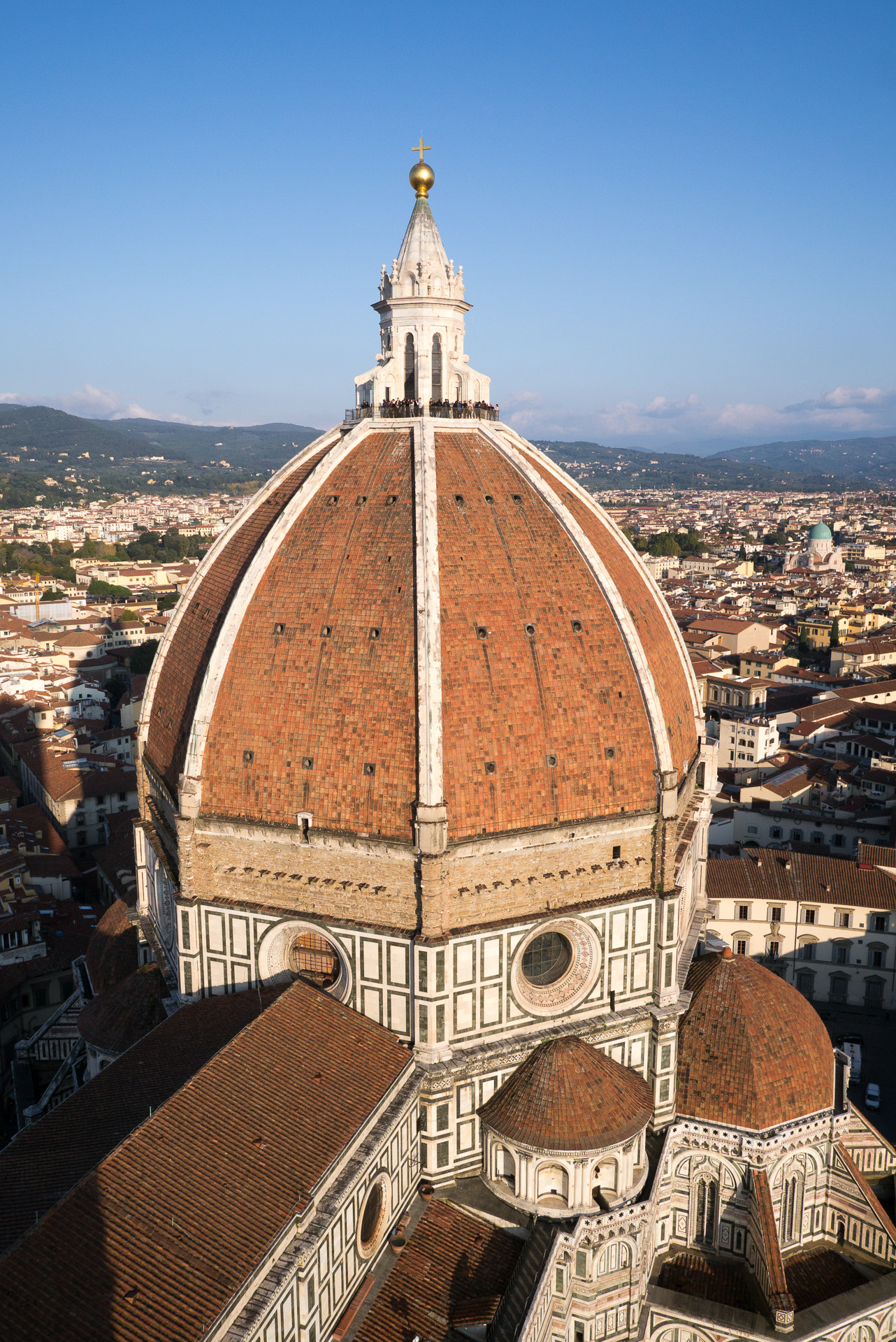
In the early 1400s, Florence had a problem. Its cathedral had a huge opening in the roof, roughly 140 feet across, where a dome was supposed to go. No one knew how to build a dome that big.
The man who solved it, Filippo Brunelleschi, was trained as a goldsmith. He used geometry to design a dome that could support itself as it rose. He invented new hoisting machines to lift the materials. He also helped pioneer linear perspective, the math that lets artists show depth on a flat surface. The finished dome was engineering, art, and worship in one structure. Nearly six centuries later, it is still the largest brick dome ever built.
Science, technology, faith, engineering, art, and math. Every letter of STREAM is in that dome.
A City at the Intersection
That breakthrough was not a fluke. Florence in that era drew talent from everywhere. The Medici, a wealthy banking family, paid for the work of creators in many different fields. Sculptors, scientists, poets, philosophers, painters, and architects ended up in the same city, trading ideas across disciplines. The Renaissance grew out of those collisions.
In his book The Medici Effect, Frans Johansson argues that this pattern repeats throughout history. He describes a place where different fields stream together toward a single point. He calls that place the Intersection, and the burst of new ideas that happens there, the Medici Effect.
“Stream together toward a single point.”
Frans Johansson, The Medici Effect
Read that phrase again. Different fields, streaming together toward a single point. That is STREAM.
What Johansson Found, and How STREAM Answers It
What Johansson found
How STREAM answers it
Breakthroughs cluster where different fields meet.
STREAM projects are designed to pull from several disciplines at once.
Expertise builds mental habits that keep us in our lane.
Students practice switching lenses. How would a scientist see this? An artist? An engineer? What does Scripture say?
Broad learning and self-teaching break those habits.
A broad program across six areas, plus a self-paced core where students learn to drive their own learning.
Depth still matters. The goal is balance, not dabbling.
Core subjects are still mastered through accredited, college-prep coursework. Projects add breadth on top of depth.
Innovators generate lots of ideas and keep records of them.
Idea journals and project work kept over time, in the spirit of the notebooks Leonardo and Edison filled.
New ideas usually fail before they work.
The design cycle: build, test, fail, improve. Failure is treated as information, not defeat.
Diverse teams find more intersections.
Project teams mix students with different strengths and interests.
Faith at the Center
Why the R Is at the Center
Many schools teach STEM and add a Bible class on the side. Enlightium does it the other way around. Faith is the lens for every subject.
That is not a modern idea pasted onto an old one. The Renaissance was not a secular project. Many of its greatest works, from Brunelleschi's dome to the ceiling of the Sistine Chapel, were made for the church and offered to the glory of God.
Scripture paints the same picture. When God called for the tabernacle to be built, He filled a craftsman named Bezalel with His Spirit, and with wisdom, understanding, knowledge, and skill in every kind of craft: design, metalwork, stonecutting, and woodwork (Exodus 31:1-5). Creativity and craftsmanship are gifts to steward, not distractions from faith.
It is the glory of God to conceal a thing: but the honour of kings is to search out a matter.
Proverbs 25:2 (KJV)
Curiosity honors God. Searching things out is part of how we were made.
Why This Matters Even More With AI
AI can help a student build almost anything. It cannot tell them what is worth building, who it might hurt, or whether it is true. Those questions take wisdom, empathy, and a moral compass.
That is why the R carries two words. Reading trains students to weigh sources, spot weak arguments, and notice when something sounds right but isn't. Religion trains them to ask what is good, what is just, and who they're serving. In a world flooded with instant answers, discernment becomes one of the rarest skills of all.
What doth the LORD require of thee, but to do justly, and to love mercy, and to walk humbly with thy God?
Micah 6:8 (KJV)
The AI Era
Built for the AI Era
Today's students will spend their careers working alongside AI. That changes what school needs to do.
The World Economic Forum's Future of Jobs Report 2025, based on a survey of more than 1,000 employers worldwide, paints a clear picture. Johansson saw part of this coming. In 2004 he named three forces that were multiplying intersections around the world: people moving between cultures, sciences converging, and rapid leaps in computing. AI is the biggest leap in computing yet, and it puts that force in every student's hands.
#1
The fastest-growing skills are technical: AI and big data, networks and cybersecurity, and technological literacy.
7 in 10
Analytical thinking is still the top core skill. About seven in ten employers call it essential.
Rising
Creative thinking, resilience, flexibility, and curiosity are rising in importance too.
2 in 5
Employers expect about two-fifths of workers' core skills to change by 2030.
Both
Growing jobs increasingly need technical skills and human skills together.
Six Reasons STREAM Fits a World With AI
01
AI handles the predictable. People who connect fields stay valuable.
AI learns from patterns in work that already exists, so it excels at directional tasks: the next logical step, the expected answer. That kind of work gets cheaper every year. The value shifts to people who can frame new problems and combine fields in ways no one asked for.
02
When the rules change, broad learners adapt.
Remember the bridge players. AI is rewriting the rules of many careers at once. Students who are used to moving between fields are built for that kind of change.
03
Students learn to build with AI, not just use it.
In Enlightium Prep's technology strand, students create apps, prototypes, and AI-powered projects. They learn to direct AI agents and set up simple automated workflows. Using AI on real projects, with real stakes, teaches more than any list of rules.
04
Judgment is the new scarce skill.
When answers are instant, the valuable skill is knowing which ones to trust. Reading builds discernment about what is true. Faith builds discernment about what is right.
05
The real world still matters.
AI can draft a design. Someone still has to build it, test it, and make it work for a real person. Engineering and the arts give students skills that live in their hands and their relationships, not just on a screen.
06
Real work shows what students can do.
Employers are putting more weight on proven skills, not just credentials. STREAM students graduate with a body of real work to show, not just grades to report.
The Research
What the Evidence Says
No study has tested the STREAM label itself, and we'd rather say that plainly. But its building blocks have strong research behind them.
2 years
Project-based learning can raise achievement
In a randomized controlled trial, the gold standard in education research, students in project-based AP U.S. Government and AP Environmental Science classes outscored students in lecture-based classes on their AP exams. The pattern held for two years, in both courses, and for students from lower- and higher-income families (Saavedra and colleagues, 2021).
10,548
The arts improve more than art
A large randomized study in Houston followed 10,548 students in grades 3 through 8 at 42 schools. Students who got more arts learning had fewer discipline problems, better writing scores, and more compassion for others. Elementary students also showed stronger engagement with school and higher college aspirations. The study found no measurable change in math or science scores, which is a useful reminder: the arts strengthen a school, they don't replace core instruction (Bowen and Kisida, 2019).
Both
Employers want the combination
As the World Economic Forum data shows, the jobs that are growing need technical skills and human skills at the same time. STREAM is built to develop both.
What Students Gain
01
Learning that sticks.
Knowledge that connects to other knowledge is easier to remember and easier to use in new situations.
02
Real engagement.
Students work harder when the work is real and someone is counting on it.
03
Creative confidence.
Creativity is a skill. It grows with practice, and STREAM builds in practice every week.
04
Grit.
Projects fail before they work. Students learn to keep going and fix what's broken.
05
Faith as a way of seeing.
Students connect what they believe to everything they study, not just one class period.
06
Teamwork and communication.
Students learn to explain their ideas, take feedback, and build with others.
07
Proof of ability.
Finished projects show colleges and employers what a student can actually do.
Comparing Options
How STREAM compares
Christian families have real choices. Here is an honest look at the most common school models.
| Quality | Traditional private school | STEM school | Classical Christian | Online or homeschool only | Enlightium Prep Online |
|---|---|---|---|---|---|
| Connects subjects to each other | Light | Some | Strong | Varies | Strong |
| Hands-on building and design | Some | Strong | Light | Varies | Project-based |
| Creativity and the arts | Some | Light | Some | Varies | Strong |
| Faith at the center | Varies | Rare | Strong | Varies | Strong |
| Technology and AI skills | Some | Strong | Light | Some | Strong |
| Live teachers and classmates | Strong | Strong | Strong | Light | Strong |
| Schedule | Full day, fixed | Full day, fixed | Full day, fixed | Fully flexible | Structured mornings, free afternoons |
| Commute | Yes | Yes | Yes | No | No |
Ratings describe each model's typical design, not any single school. A great teacher can make any model work, and a weak one can undo any model. Enlightium Prep Online students set their own pace within a weekly rhythm. Campus students follow a structured school day.
Where Other Models Shine
Classical Christian schools excel at writing, logic, rhetoric, and great books. That tradition lives on in Enlightium's Inquiry Hub, where students build arguments and debate. STEM schools offer deep technical training, and STREAM keeps that rigor while adding the arts and faith. Montessori builds early independence, and Enlightium's self-paced core builds the same habit. Traditional schools offer proven structure, and Enlightium keeps the structure while adding flexibility.
STREAM at Enlightium is not a rejection of these models. It borrows their best ideas and adds what a world with AI demands.
Why Enlightium
The Enlightium Difference
Other schools use the word STREAM. Here is what makes Enlightium's version different.
01
Faith at the center, not on the side
Every subject is taught through a biblical worldview. Bible study, Scripture memory, and chapel on campus make faith part of the weekly rhythm, not an add-on.
02
A schedule that frees time for real projects
Most schools spend their best hours on lecture. Enlightium Prep is built so core learning is efficient and well supported, which leaves real time for building and creating. Online students move through self-paced coursework Monday through Thursday, with live teachers, small-group workshops, and daily study hall, and Fridays belong to STREAM Hubs. On campus, mornings focus on core academics and afternoons open up for hands-on exploration in maker spaces.
03
A workshop and an academy
Renaissance Florence had both. Young artists learned by making things in workshops, the way Leonardo da Vinci trained under the painter and sculptor Verrocchio. Scholars debated big ideas in a circle that Cosimo de' Medici supported, later known as the Platonic Academy. Enlightium Prep has both too. In the Builder Hub, students might prototype an app or make a short film. In the Inquiry Hub, they might prepare a debate or stress-test an argument with their cohort. Makers and thinkers, side by side.
04
AI skills built in
Students don't just hear about AI. They build with it, from apps and prototypes to AI-powered projects, with the R as their guardrail.
05
Room for real lives
Enlightium Prep Online's school day ends at 12:30 p.m. Pacific. That leaves afternoons for sports, music, family, and work, so student-athletes, performers, and traveling and military families can pursue what matters without falling behind.
06
A proven foundation
Enlightium has served more than 30,000 students over 20-plus years. Enlightium Prep is accredited by Cognia and ACSI, approved by the NCAA, and recognized by the College Board as an AP school.
In the Classroom
STREAM in Action
Here is what STREAM can look like at three ages. These are examples of the approach, not a fixed syllabus.
Elementary, grades 3-5
The Neighbor Garden
S
Plant life cycles, soil, water and sunlight.
T
Time-lapse photos and a simple growth log.
R
Stories about gardens and generosity, and what Genesis 2:15 says about caring for creation.
E
Design a self-watering planter from recycled bottles, test it, then improve it.
A
Illustrate seed packets and garden signs.
M
Measure growth every week and graph the results.
Project photo coming soon
The Project
Grow food to share with a local food pantry.
Middle school, grades 6-8
The Dome Challenge
S
Forces, compression, tension and why arches stand.
T
Design interlocking bricks in a 3D modeling tool and print them.
R
Read about Renaissance Florence. Ask why people built cathedrals meant to last for centuries.
E
Build it, load-test it, watch it fail and rebuild it stronger.
A
Sketch the design in one-point perspective, the technique Brunelleschi helped pioneer.
M
Use geometry and ratios to plan the curve.
Project photo coming soon
The Project
Build a dome that holds itself up, inspired by Brunelleschi.
High school, grades 9-12
Clean Water, Real Data
S
Water chemistry and contamination testing.
T
Build an AI-assisted tool that logs test results and flags problems.
R
Read case studies critically, and study what Jesus says about serving people in need (Matthew 25:35-40).
E
Prototype a low-cost filter and measure how well it works.
A
Produce a short film and pitch that tell the story with care and respect.
M
Calculate flow rates, cost per liter and how confident the results really are.
Project photo coming soon
The Project
Help a mission partner test and improve its water supply.
For Students
What This Means for You
01
You will build real things, not just fill in worksheets.
02
You will get things wrong, then figure out why. That is how every inventor works.
03
You will learn to use AI the way a skilled craftsman uses a power tool: with care, skill, and a clear purpose.
04
You will see how your faith connects to everything you study.
05
You will build a body of work you can show colleges, scholarship committees, and employers.
06
You will learn to ask better questions. In a world full of instant answers, a great question is rare.
Try the Leonardo Test
Next time you're stuck, look at the problem three ways. How would a scientist see it? How would an artist? What does Scripture say about it? You may find the answer waiting at the intersection.
Share It
STREAM in a Nutshell
Need to explain STREAM to a friend, a new family, or a grandparent? Start here.
- History. The Renaissance came from people who crossed fields. Frans Johansson calls it the Medici Effect, and STREAM is built on the same idea.
- Research. Randomized studies show that project-based learning and arts learning improve real outcomes for students.
- The job market. The World Economic Forum's 2025 employer survey shows growing jobs need technical and human skills together.
“STREAM stands for Science, Technology, Reading & Religion, Engineering, Arts, and Math. Most schools teach those as separate boxes. We teach students to connect them, with faith at the center. That matters more than ever, because AI can handle predictable work. What it can't do is connect ideas across fields, build real solutions, and judge what is true and right. That's exactly what STREAM trains.”
Questions families ask
Is STREAM just STEM with a Bible class?
No. A Bible class is one period a day. At Enlightium, faith shapes how every subject is taught: how students do science, use technology, design solutions, make art, and reason through problems. That's why the R sits in the middle of the word.
Does all the project work come at the expense of academics?
No. Core coursework is accredited and college-prep, and projects build on top of it. The research points the same way: in a randomized study of AP courses, project-based classes outscored lecture-based classes on the AP exam.
Why not a classical Christian school?
Classical schools do many things well, especially writing, logic, and great books. If those matter to you, you'll find them here too, especially in the Inquiry Hub. STREAM adds what classical models often leave out by design: hands-on building, engineering, technology, and AI skills.
If AI can do so much, why learn the basics?
Because you can't judge what you don't understand. Students who know the fundamentals can tell when AI is wrong and push it to do better. Students who don't are stuck trusting whatever it says.
Does research prove STREAM works?
Honestly, no study tests the STREAM label itself. Strong studies support its building blocks: project-based learning, arts learning, and the mix of technical and human skills employers want. Johansson's work on innovation explains why combining fields matters. We'd rather tell you that plainly than oversell.
How does STREAM work online versus on campus?
Same framework, different rhythm. Enlightium Prep Online runs core learning Monday through Thursday, with Fridays for STREAM Hubs and Bible study. Enlightium Prep Campus pairs morning core academics with afternoon hands-on exploration, maker spaces, and weekly chapel. Families who need a fully independent pace can choose Enlightium Academy.
References
Sources
- Frans Johansson, The Medici Effect (Harvard Business School Press, 2004).
- World Economic Forum, Future of Jobs Report 2025.
- Anna Rosefsky Saavedra and colleagues, “Project-based learning in AP classrooms: Lessons from research,”Phi Delta Kappan, November 2021.
- Daniel H. Bowen and Brian Kisida, “Investigating Causal Effects of Arts Education Experiences: Experimental Evidence from Houston's Arts Access Initiative,” Houston Education Research Consortium, 2019. Summary in Education Next.
- Enlightium Prep, program and STREAM framework, and Enlightium Prep Spokane.
Scripture quotations are from the King James Version.
See STREAM in Action for Your Student
Schedule a free family consultation to see how STREAM works at Enlightium and what it could look like for your student.
No pressure. No commitment. Just a helpful conversation.
Free. Takes about 20 minutes. And you'll know if Enlightium Prep is right for your family.
